Welcome back to “Around the House!” After a hiatus, the monks of Saint Meinrad Archabbey are thrilled to share with all of you, the members of our extended community, some interesting bits of news about our life together. Countless people often wonder what monks do all day besides pray. “Around the House” is here to offer you a bimonthly glimpse into the cloister to see how we recreate together, express our creative sides through diverse hobbies, and share some simple wisdom that takes on profound meaning when lived in the presence of God.
This is Br. Stanley, the new correspondent for “Around the House.” For our Nov./Dec. 2025 issue, I have three items to share with you.
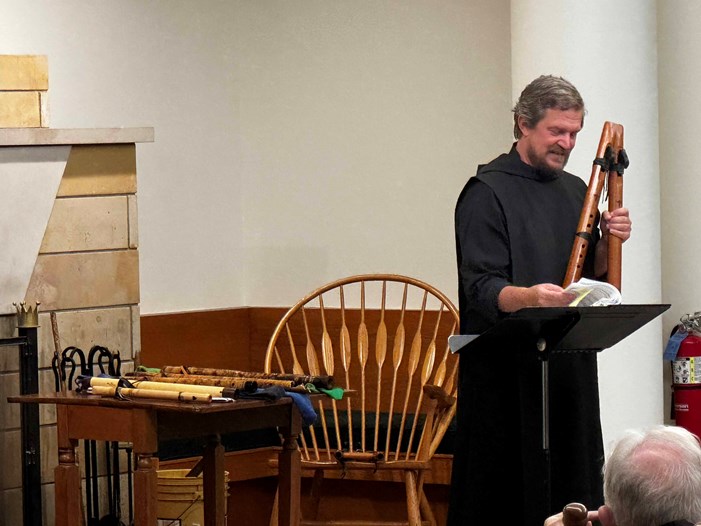
For the month of September, we hosted Fr. Michael Peterson, OSB, monk of St. John’s Abbey, Collegeville, MN, and former member of Blue Cloud Abbey, a daughterhouse of Saint Meinrad that ministered among Native American peoples from 1950 until 2012. Fr. Michael is currently on sabbatical and included Saint Meinrad as a stop to enjoy time with his former Blue Cloud confreres, Fr. Denis Quinkert, OSB, and Fr. John McMullen, OSB. While here, he regaled the monastic community with a flute concert before Compline on Monday, September 29. Fr. Michael’s recital contained compositions from Native American musicians as well as one of his own pieces. Reflecting on how his monastic life has influenced his music, Fr. Michael commented that Blue Cloud’s missionary work didn’t just share the treasures of Catholicism with the Sioux people, but the Sioux people also changed the missionaries—a sign, he said, of authentic evangelization and mutual obedience (RB 71).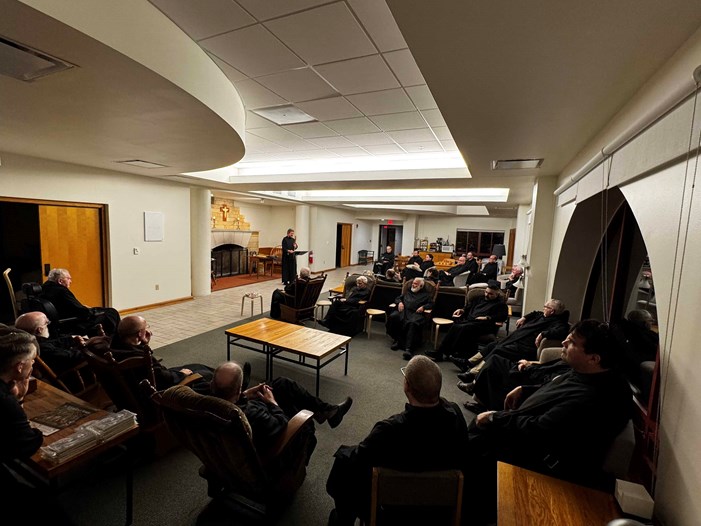
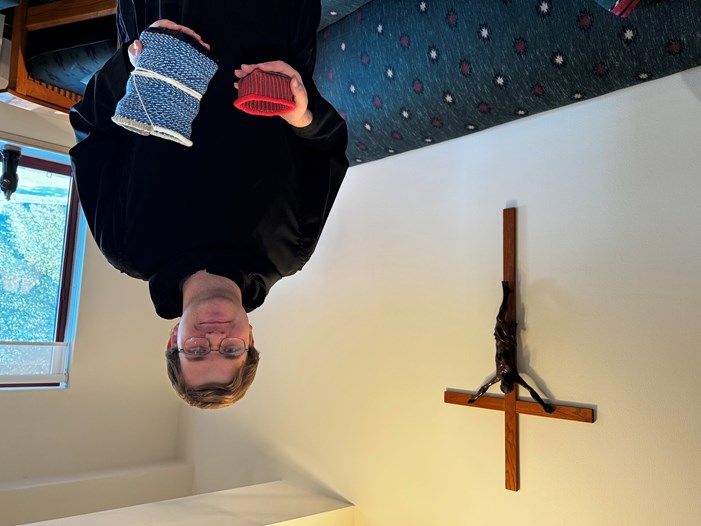
Basket weaving is quickly becoming another source of monastic leisure. Besides Br. Jean’s workshops offered in our Guest House and Retreat Center, he’s also imparting his love for creating unique works of art that please the eye and also fulfill practical uses. For the past six months, Nov. Douglas Allison, OSB, has been crafting various kinds of baskets in even more intricate patterns and colors. Nov. Douglas said that basket weaving is an excellent hobby to practice because “I can do it in my free time, and I don’t have to leave my cell.” He usually does leave his cell, though, because you can find him in our Calefactory [living room] before Vespers most evenings. Another benefit of basket weaving is its sustainability—“Yarn is pretty inexpensive, and the baskets can be reused or repaired.” While admiring two of his creations, I remarked how difficult the work seems. Nov. Douglas reassured me that it’s not as intimidating as it first appears. When asked if he plans to sell some of his baskets at Saint Meinrad Books & Gifts, he was open to the possibility in the future.
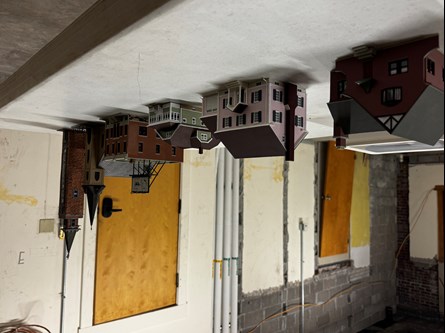
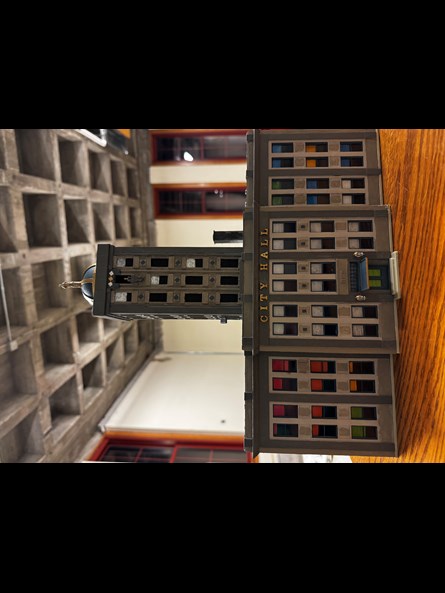
Finally, I offer you a glimpse into my workshop on 6th floor, St. Bede Hall where I’m in the process of building an HO scale model train layout. I first got into model railroading as a boy because it was my dad’s hobby, and I took it up again because I needed something fun (other than the archive) to keep me focused. I don’t have the bench work (tables) set up to accommodate a running train—that’ll come in due time. For now, I’ve been painting and assembling structure kits, and I’ve even ventured into scratch building and customization. I designed and built a “stone” water tower for my HO scale town of New Hellimer. Another structure I’ve been working on is the New Hellimer city hall—it’s a Walthers Cornerstone kit to which I’ve added a tower that I scratch built and painted. Model railroading’s appeal to me is the diversity of options it provides for each person—some people prefer operating the trains, others like sculpting natural scenic wonders, and there are people like me who like scaled down urban planning and assembling buildings.
Most people are stunned to learn that monks are real people. This is no doubt in part to a “Hollywood image” of monastic life that pervades our culture—praying in church all day, making a vow of silence, never leaving the enclosure of the monastery. The cloister (the enclosure of the monastery) is meant to set us apart from the world in a physical sense, but we bring real human needs and wants into that cloister so God may purify them for us. [In my case, a hobby is a welcome tool for me to control my control issues.] Hobbies, crafts, trades, and interests aren’t just good for monks to do to pass the time when not in church. They assist us in focusing on what’s important in life, such as becoming more patient, practicing more charity, or learning to prefer nothing to the work of God (RB 43:3).
Such wisdom from our cloister shouldn’t remain simply “around the house” but should be shared in abundance.