July 2026
Br. Stanley Rother Wagner, OSB
Tuesday, July 21, 2026
Welcome back to Around the House, your source for the latest news from inside the cloister of Saint Meinrad Archabbey. As summer progresses here on the Hill, we monks are daily living the vows we professed or, in other words, continuing that for which we are well-known—praying, working, and being witnesses to Christ’s peace.
Summer on the Hill has two chief drawbacks: heat and humidity. A summer rain may bring an ounce of respite from atmospheric sogginess, though there is another way for us to refresh ourselves—to enjoy the slower pace that descends around the house and on the Hill. During the academic year, having the sounds and sights of seminarians and students pulsing around the complex is a sign of vitality and a manifestation of God’s overflowing grace… but it can also deplete even the highest levels of “good zeal” (see RB Ch. 72). Summer affords us monks the blessed time to complete our work and tasks, though always remembering, “The work will be there tomorrow.” Especially during the summer, we find time each day to get out and walk (if it’s nice out) or pry ourselves away from our computers to read a book or to assemble a model, all while recollecting in the peace of God’s presence.
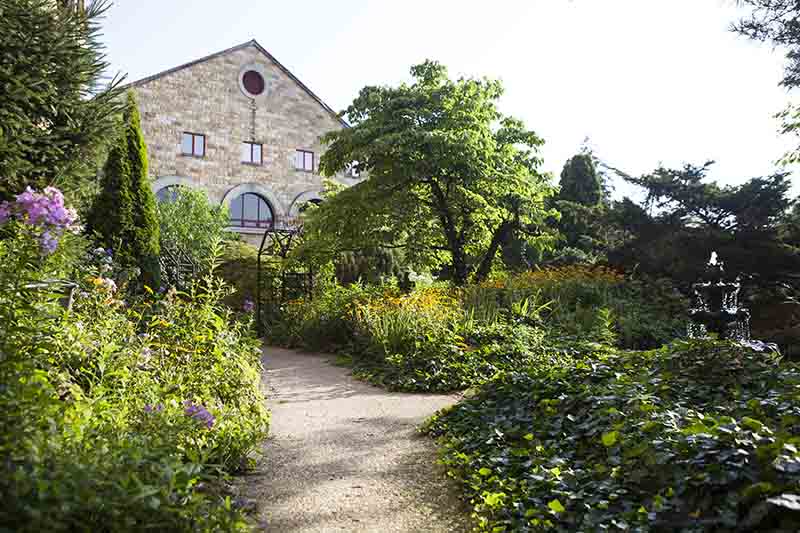
One person who’s learning the timeless peace of Benedictine monasticism is a new addition to our community, Candidate David Hensler. Cand. David, a native of Marietta, OH, began his candidacy—the first period of formation, usually three months, in mid-May and has been settling into the daily tempo of prayer, work, and leisure that comprise the monastic horarium. A nurse by profession, he’s gaining insight into how the monastic life is detailed and demanding like nursing, though more regulated and consistent. One of the challenges of the horarium that Cand. David mentioned is the early risings, “The day is profoundly governed by the bells, which is a blessing,” though he added, “the bells make sleeping in a lot harder to accomplish.” He’s coming to see just how much monks can achieve with a regulated schedule. “From music, cooking, crafts, teaching, ministry, and agriculture, we accomplish much … because the day is given to God in constant prayer and so blesses the fruit of our labor.” A labor to which Cand. David has been assigned during this first step of his formation is working in the archive with Br. Evagrius and me. Not only has he been doing excellent work with abundant gusto, but Cand. David is learning that when completing a task, it’s vital to stop and take in the significance of the present moment. “This job is also a treat because I get to see much of the abbey’s history.”
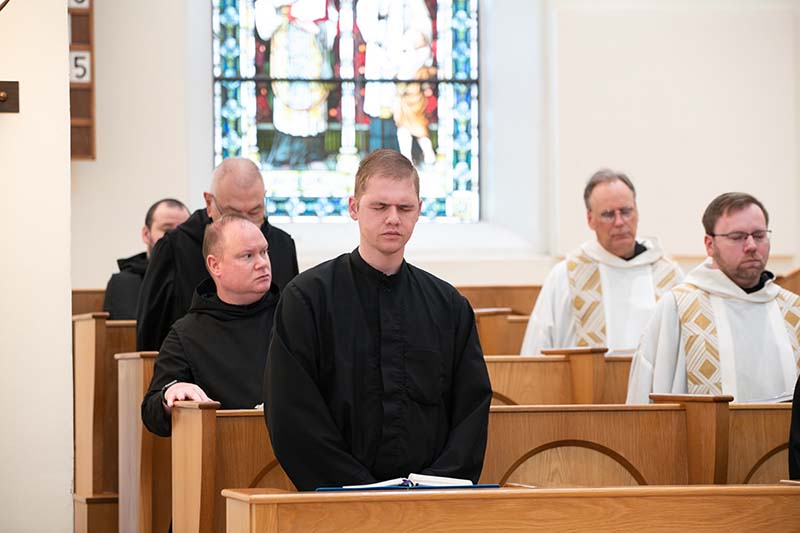
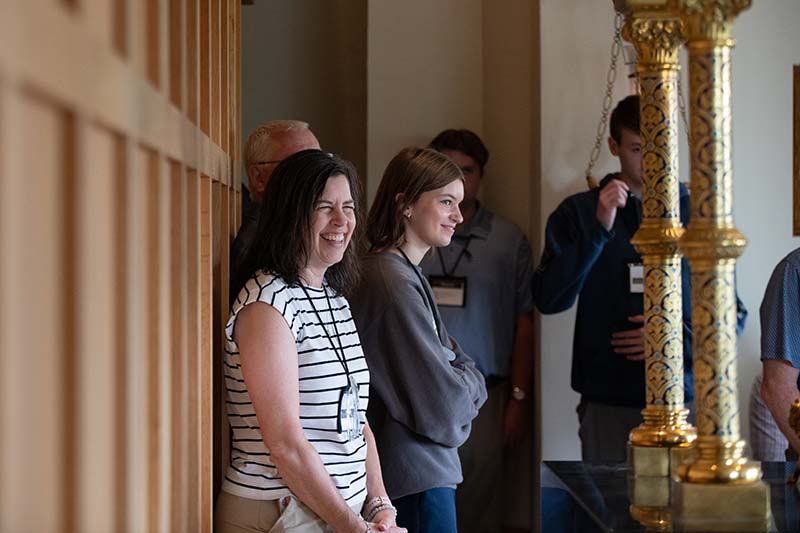
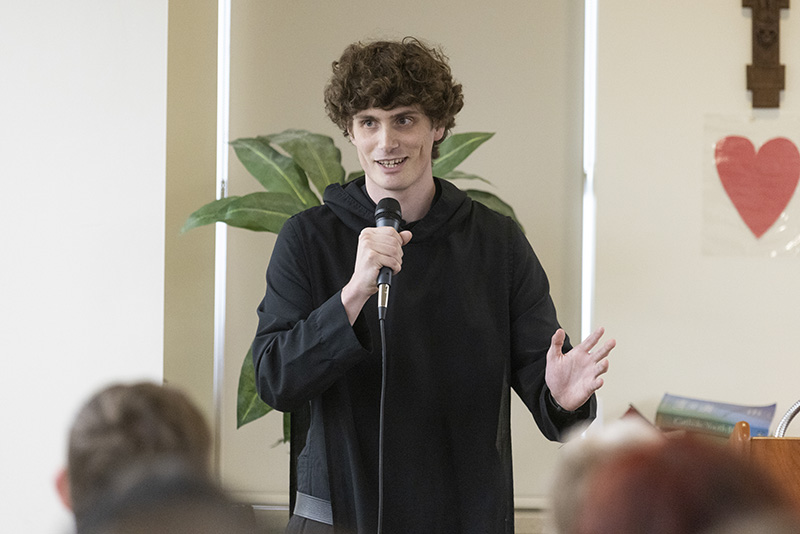
History is all around the archive, true, though this is equally so of the house and the Hill in general. One can feel the past in the aged buildings and timeworn trees that beautify Saint Meinrad Archabbey, but it’s the people who live, work, and pray on this Hill who embody the history and traditions of Benedictine monasticism. A visible sign of these traditions being lived is when we assemble for the liturgy or our common meal, and it’s true of the guests and pilgrims who make their way to us. Guests make Christ’s presence felt to us in a special manner since we are to receive them as Christ himself (see RB 53:1). These people journey to Saint Meinrad for a modicum of peace, especially during the “busyness of summer.” The “One Bread, One Cup” [OBOC] program is one of these groups. With OBOC in the full swing, the college interns are continuing their work in forming young people to participate actually, fruitfully, and prayerfully in the liturgy. During the weekend of June 19–21, the Hill hosted the annual family weekend, where the interns, their families and friends, and OBOC alumni assembled to enjoy some summer fun, as well as offer prayerful support for the current crop of interns. The second of three conferences began on Friday, June 26, and for the second conference, Br. Isaac Levering, OSB, a junior monk of Saint Meinrad Archabbey, offered a talk on lectio divina.
One of seven men in formation at Saint Meinrad Archabbey, Br. Isaac is a man of many talents. Before coming to the monastery, he earned a bachelor’s degree in theology from Hope College in Holland, MI, then worked for several years at two Menards locations. He currently serves as guest master of the juniorate, among other liturgical and house assignments. Reflecting on his work and life experience prior to becoming a monk, he said, “… working at Menards taught me to roll with the punches and to adapt to new things.” Two of the new things that have presented themselves to Br. Isaac are learning a language and becoming a cantor for our liturgies.
This summer, Br. Isaac was enrolled in an online “Intensive Beginner’s Greek” course through the Catholic University of America in Washington, D.C. “The class moved extremely quickly—three hours of class time every day with lots of forms and constructions to memorize outside of class; it really pushed me.” His interest in Greek has been developing since the latter days of his undergraduate career. “My final semester of college, I took a survey course of the Platonic tradition, ranging from Plato to Emerson, which got me interested in continuing to read Plato ... and most recently, Dr. Kolb and I read tragedies.” Closing our interview, I asked Br. Isaac what possessed him to take an intensive online course in the summer. “I’ve enjoyed having a chance to work hard at something that I personally very much wanted to do, as a kind of exercise in healthy ambition.” In the meantime, he’s also been honing his musical skill. “I’ve gotten into country music as a hobby,” to the point that one of his “semi-serious life goals” is someday to make his own country music album. This hobby began with him taking a more active role in singing at Office and Mass. “Becoming a singer and cantor in the liturgies has certainly been one of those new things that I never would have imagined doing, but which has turned out to be a joy,” a joy he says is “the most unexpectedly awesome thing” he gets to do on the Hill.
Liturgy is one of two outstanding qualities that come to mind when someone mentions Saint Meinrad Archabbey—hospitality is unquestionably the other quality. The liturgy anchors each Christian in the sure hope of finding a firm hold on Christ in spite of the swift currents of change that are pulsing through our world. The liturgy is the place where each of us can have a privileged and personal encounter with God, since he is most assuredly present when we assemble to worship him (see RB 19:1-2). This privileged and personal encounter, when one is properly disposed and formed, enables a peaceful disposition to permeate the person and convert him or her into a “little Christ,” spurring that person on to go into the world and love as Christ loves and to be Christ for one’s neighbor. The slower pace of summer gives us monks the freedom to slow down, for each of us to become a “little Christ,” and to allow his divine peace to transform our prayer, work, and leisure, across the whole world ... but first and foremost around the house.
Br. Stanley, OSB
Around the House correspondent