September 2026
Br. Stanley Rother Wagner, OSB
Friday, September 18, 2026
Hello, readers of Around the House, and welcome to our September issue! In the July edition, we discussed the time-honored practice of monastic leisure. Life on the Hill has been leisurely since then, though the past two weeks have brought changes to the Hill, changes that occur this time each year. Our seminarians and students have returned for the fall semester. And like the autumnal leaves, the fresh and familiar vibrancy of a new semester adds yearned-for color to the waning light of this year’s days.
The fall is always a special time—it’s a season of endings becoming beginnings: a period of transfiguring decay and emerging wholeness. The panoply of green leaves transforms and gives way to warm shades of orange, yellow, and red, plants that wither and fall, then become useful to the soil. Society has dulled our senses to the beauty of death, to the divinizing grace of acknowledging that one’s role in the ongoing history of salvation lasts only for a fleeting time. Our time is fleeting, yes, but God’s time is eternal—an ancient mystery people from all walks of life have discerned anew throughout the ages.
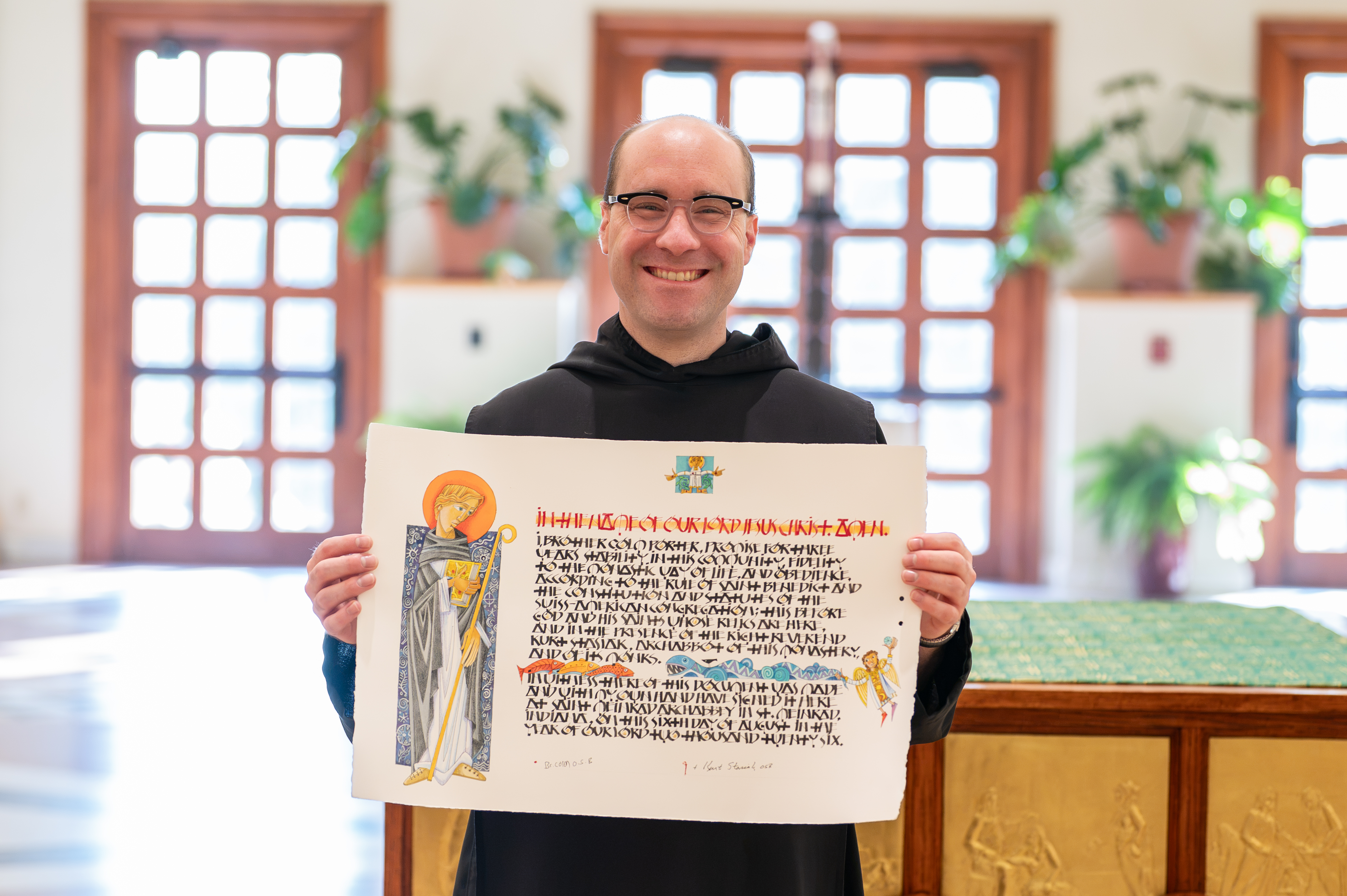 One of those people is someone you already know, though he’s been given a new name. Novice Keegan Porter, OSB, professed his simple vows on August 6, 2026, the Feast of the Transfiguration. Archabbot Kurt gave him the name Colm (pronounced like “column”), though even this new name is quite familiar to him. “Colm is taken from Columba, which is the Latin spelling of the name,” he explained.
Brother Colm’s family has connections to St. Columba himself. “It’s well known among our community that I’m proud of my Irish heritage, but there’s another aspect of my family roots that isn’t as well known.” His paternal grandmother’s maiden name was “Locklan,” derived from the traditional Scottish clan name “MacLachlan,” a dynasty of which St. Columba is a member.
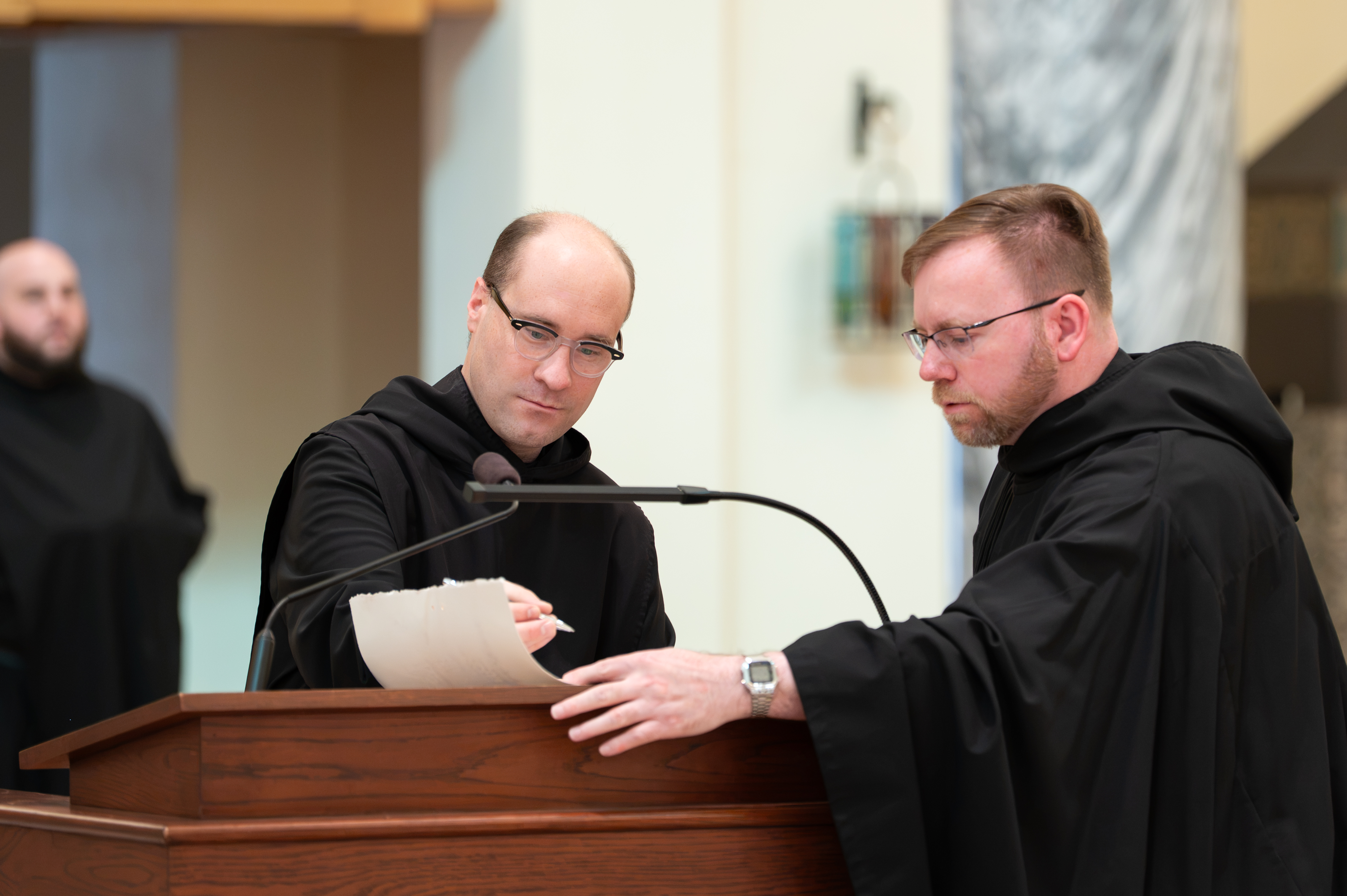 Before entering Saint Meinrad Archabbey as a candidate in August 2025, Brother Colm had professed simple vows as a monk of Mount Angel Abbey in Oregon, and was given the name Columba. When asked about Archabbot Kurt’s response to his list of proposed names, Brother Colm replied, “Abbot Kurt’s reaction was one of calm consideration.” [If I may editorialize for a moment, Father Abbot was probably considering how cool it is to have an unbroken track record of granting newly professed monks their first choice of names.] This is simply one layer of meaning on top of many more that has generational significance to him and his family, and now for us as a community.
For the immediate future, Brother Colm has a new assignment. “I’m starting my first year of theology as a seminarian and hope to continue my studies for the priesthood.” We wish him all the best and ad multos annos!
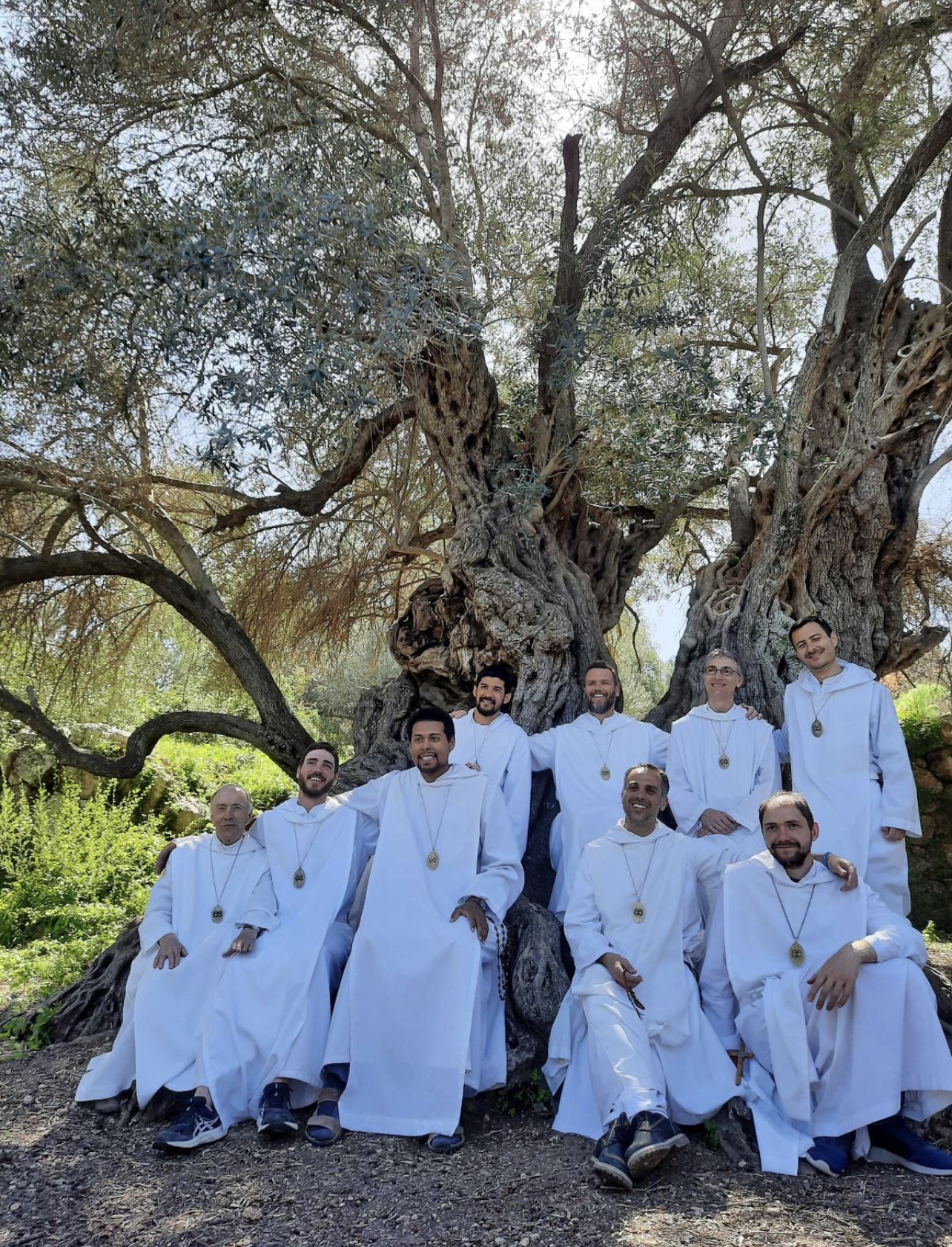 If you tune into the livestreamed liturgies on a regular basis, you may have noticed a new monk who’s living with us in the cloister while studying in our seminary. Brother Joseph Mary, OSB, will be with us for two semesters in preparation for ordination to the priesthood. Brother Joseph and his community—the Benedictines of Divine Will—stand out for many reasons.
If he looks familiar, that’s because he was a seminarian who studied in our seminary, earning an MA in Catholic Philosophical Thought and an MA in Theology in 2019. “I had the option to study elsewhere,” he said. His other two options were Saint Vincent Seminary, Latrobe, PA, or the Aquinas Institute of Theology, Saint Louis, MO, though he chose to re-enter Saint Meinrad Seminary and School of Theology. “Saint Meinrad was preferred as I had studied here previously for the Archdiocese of Mobile. It is where... the Knoxville [seminarians] are, and it is an excellent monastery/seminary overall.”
The Benedictines of Divine Will are relatively recent additions to the assembly of religious communities. Since they are newer, they don’t yet possess the status of a religious community. “We are currently a Public Association of the Faithful in two dioceses—San Marino-Montefeltro, Italy, and Knoxville, TN,” Brother Joseph explained. They trace their roots back to 2009, when Father Elijah, a former monk of Saint Vincent Archabbey, discerned with Mother Gabrielle Marie, a former Poor Clare nun, to begin a new monastic foundation, based on both The Rule of St. Benedict and the spirituality of Servant of God Luisa Piccarreta. Brother Joseph said, “Our life centers on the Eucharist, the Divine Office, work, hospitality, and the desire to live ‘on earth as it is in heaven’ by remaining in God’s Will, or to say it another way: the ‘little way of Nazareth.’” As of 2026, there are 12 brothers and 12 sisters, with nationalities from the United States, Italy, Korea, India, Moldavia, Croatia, the Philippines, and Mexico.
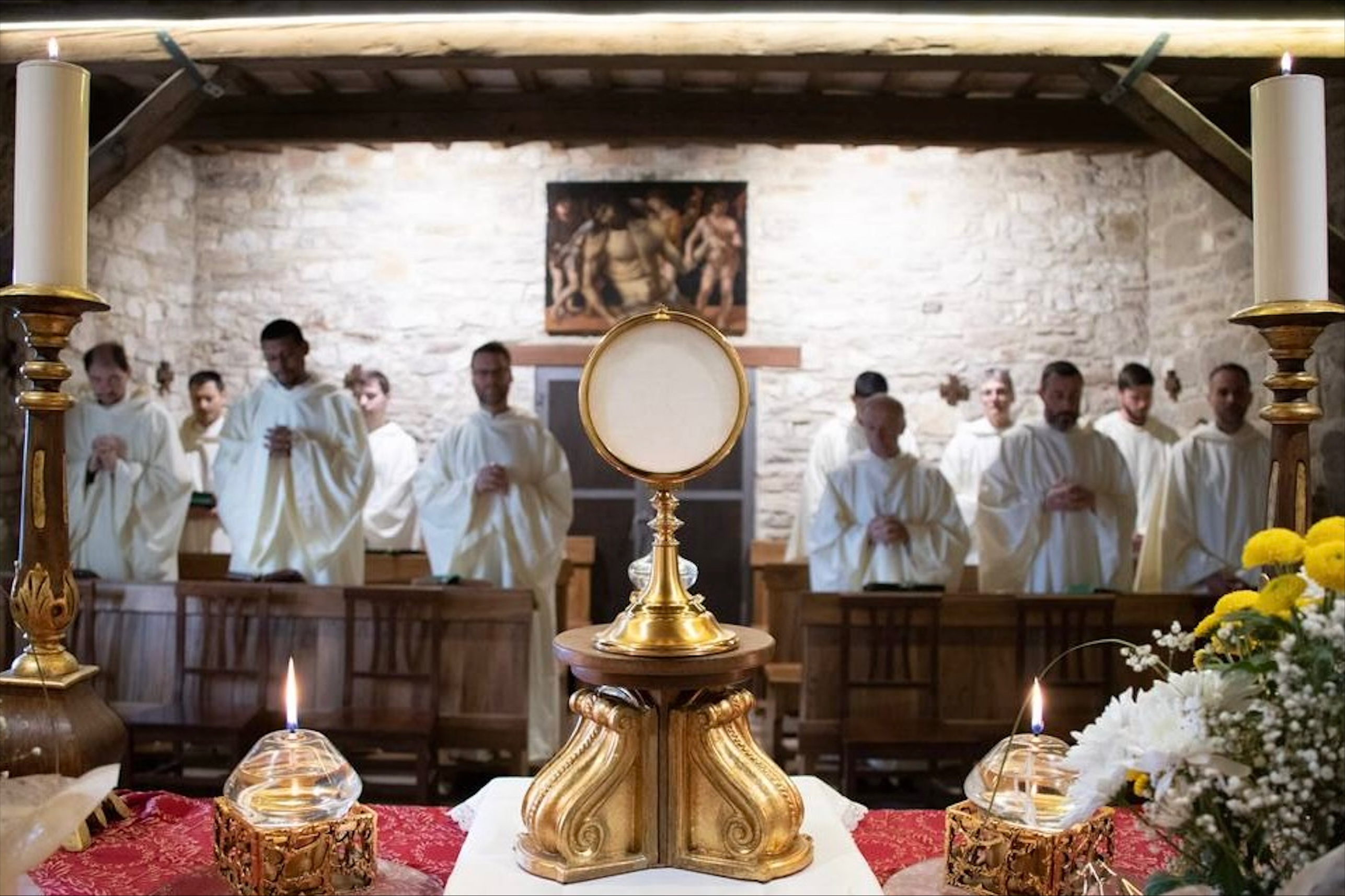 A further distinction may be of interest. The Benedictines of Divine Will wear white habits primarily as a symbol of Our Lady’s purity. Brother Joseph explained, “There are other meanings attached to the color as well, like the ‘white garments’ of the blessed.”
The white garments of salvation that clothed us on the day of our baptisms will never fade, for they have been washed in the Blood of the Lamb (see Rev. 7:14). The shoals of the world pound against Peter’s Barque, leaving faded reminders as evidence of their presence. We can look at those dings and dents in despair, or we can hope in the everlasting words that Christ continues to speak to us: “Take courage, it is I; do not be afraid” (Matt. 14:27). God’s eternal presence is something whose vibrancy doesn’t fade or tarnish over time. It’s ever ancient and ever new, spanning not just time and space, but the entire visible spectrum of existence, here, there, and everywhere, even around the house.
Brother Stanley, OSB
Correspondent
Around the House